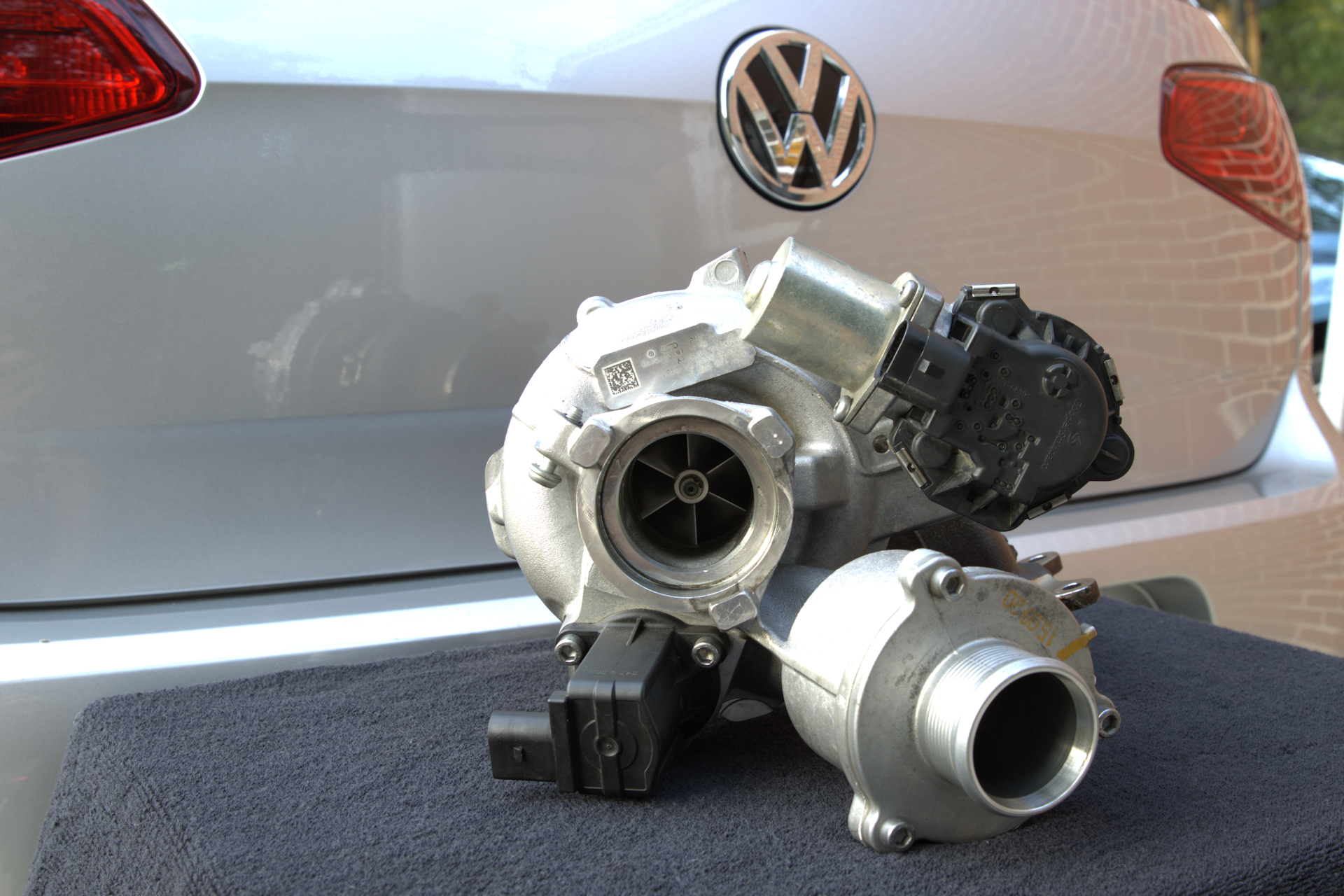
It’s been barely a month since my last expensive visit to Euro Pros in Yorktown, VA for repairs or maintenance. It’s never fun reporting fresh trouble, especially after such a recent repair. But my turbocharger recently started acting up, triggering an EPC light and a Check Engine Light (CEL) on the dashboard that put the car into limp-home mode. Pulling the fault codes revealed two specific issues that I’ll share below.
I was driving gently since I was still bedding-in a new clutch. I could clear the EPC indicator by restarting the car. The turbo builds boost, but malfunctions while cruising in rolling hills under light load, an indication of a charged air leak.
My old IS38 had over 140,000 miles on it, so I knew the day that it needed to be replaced would come sooner or later. I was hoping for later. 😉 The new clutch was not yet ready for any ” turbo testing.”
Thankfully, the car was driveable and not stranded anywhere. I continued bedding-in the clutch for another 1000 miles before resolving this problem. The intentionally light driving ensured that I didn’t over-boost the turbocharger or otherwise harm the engine.
This image shows that the fault was within the Boost Control “A” Module, aka the electronic wastegate actuator (O2 Sensor fault was pre-existing). A subsequent scan with a VW-specific tool indicated that the actuator was stuck. The car’s behavior was consistent with the wastegate being stuck closed enough to build boost, but open just enough to produce a low-boost leak.
The actuator can be replaced independently of the turbo for substantial cost savings. However, I didn’t think it was worthwhile on a 140,000-mile turbo. I wanted a full turbo replacement.
My outgoing IS38 was a genuine VW/Audi part that was purchased at a local Audi dealership. It was reasonably priced around $1500 in June 2021. It may have been a remanufactured Audi part. In August 2026, a genuine VW/Audi IS38 turbo listed for nearly $4000! By way of comparison, a genuine VW/Audi IS20 (stock on my car) listed for ~$1800. I considered buying an IS20 and then de-tuning the car to an applicable program.
An IS20’s snappier low-end response and quieter exhaust note on long highway trips was tempting. Then again, my car has gained ~500 lbs (227 kg) since the last time I drove it with a stock turbo. The IS38’s extra 60 horsepower (17% increase) helps to compensate for the 16% weight gain. The red in this graph shows low-end torque lost by the IS38 while the green shows its top-end horsepower gains.
I can already anticipate the comments: “XYZ.com sells an IS38 for $1400!” Yes, I know that, but I didn’t know whether I’d be buying a knock-off or a OEM part at that price. My mechanic has a reputable source for IHI turbos. If he’s backing the work, then he gets to choose the vendor! Most shops will not warranty parts or labor for customer-supplied parts anyway.
For those who don’t know, IHI is an OEM source for turbochargers for many applications. The only difference between an IHI branded turbo and a genuine VW/Audi part is that IHI stamps the VW/Audi logo on the parts that they sell to dealerships. This photo shows the manufacturer’s name cast into the turbine housing on my outgoing IS38, a genuine VW/Audi part. The photo album below shows other identifiers.
Anyway, an IHI IS38 turbocharger cost around $1800 in August 2026. With that known, I decided that installing another IS38 was the easiest plan. I also had the O2 sensor replaced during the visit.
This repair was yet another financially painful event that I expected to leave the car nearly the same coming out of the shop as it seemed when it went in. Of course, the EPC and CEL were OFF. I do appreciate driving a car with no trouble indicators!
I’m pleased to report that the new turbo spools faster, even when driving gently. My usual “grandpa driving” combined with the new clutch bed-in meant that I hadn’t given the turbo a good blast in a while. It’s great to be back to normal again! See my original IS38 article for my initial thoughts after my IS38 upgrade.
Fuel economy is as it was before, but I’ll remind you that the larger IS38 and my 3-inch turbo-back exhaust actually improves fuel economy when cruising at legal speeds due to its less-restrictive design. Look at the IS38/IS20 comparison photo shown here to see the difference in turbine wheels yourself. In short, the same characteristics that reduce exhaust restrictions for more power can also improve fuel economy when driving more efficiently. The IS38’s exhaust note a tad louder, though.
I did a round of comprehensive testing in 2021 and shared the result in this article. Of course, my decision to keep the roof rack and cargo box mounted full-time does affect fuel economy. Even with those disadvantages, my car still gets better fuel economy than a lot of larger vehicles on the road today, especially when considering its power output. I need to try another test on my open-road circuit to show what my rooftop load does in a relatively controlled setting.
With a cross-country road trip on the horizon, catching this failure at home was a blessing in disguise. The car is almost in prime mechanical shape. All that’s left is mounting a fresh set of tires and I’ll be ready to hit the road!
See the photo album below for a closer look at the turbo. I’ve also shared some direct comparisons between the IS38 and IS20 since this is the first time that I’ve had both on a bench at the same time: IS38 on the left and IS20 on the right.